


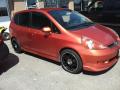
FIT build - Attempt Two.


50 Watt CAFz'r
Joined: Nov 2007
Posts: 146

 you got me

Administrator


Joined: Feb 2006
Posts: 16,860

Ultimately, IMO a breaker is inferior to a fuse. They are more convenient though.
Weirdo - What color are your underglows?
Administrator
Joined: Feb 2006
Posts: 16,860
I offered an opinion, as did you. The nice thing about opinions is they do not need proof.
I'll offer this though. As I am sure you know, but others may not, a circuit breaker works by passing current through a strip of two metals laminated together that have different expansion rates when heated. Excess current heats the metals up, they deform in a predictable manner, and the gate is opened within the breaker. This is why a breaker often has to cool down a bit before it can be reset.
In a fuse there is a strip of metal that is either riveted, welded, or soldered to the contacts. Excess current heats up the metal and it melts away, opening the circuit.
If both items function as they should, they perform essentially the same function. Excess heat caused by excess current results in the circuit being opened.
The difference is when they do not function as they should. In a breaker, there are a number of failure modes. The breaker could open as it should and then not re-close or in some other way the contacts are not reattached when closed. No biggie - replace the breaker. Being a mechanical device though, and generally installed in a harsh environment (under the hood) it is conceivable that the breaker could well fail closed. The mechanism could corrode or jam from dirt and debris. Even ice could physically keep the key from opening. The contacts could weld together when the breaker is set, or reset, if the instantaneous current draw is high. The bi-metal strip could delaminate or malfunction in another way and not deform properly, allowing the connection to continue when it should have opened.
A fuse fails in one way, it melts away and opens. The only real failure mode is if it or it's contacts open unnecessarily. While a PITA, it is not threatening. It is impossible for a fuse to fail closed. Ultimately, this is superior protection.
And why do people choose breakers anyway? Are you anticipating multiple events that will require re-setting of the circuit? I haven't changed a fuse in my car in 5 years. Why would I need a breaker? Oh..., maintenance? Just unhook the battery if that's what it takes. So, really, one could go on to argue that a breaker is only superior if one anticipates problems. If this is the case, that's poor design.
In my opinion..
I'll offer this though. As I am sure you know, but others may not, a circuit breaker works by passing current through a strip of two metals laminated together that have different expansion rates when heated. Excess current heats the metals up, they deform in a predictable manner, and the gate is opened within the breaker. This is why a breaker often has to cool down a bit before it can be reset.
In a fuse there is a strip of metal that is either riveted, welded, or soldered to the contacts. Excess current heats up the metal and it melts away, opening the circuit.
If both items function as they should, they perform essentially the same function. Excess heat caused by excess current results in the circuit being opened.
The difference is when they do not function as they should. In a breaker, there are a number of failure modes. The breaker could open as it should and then not re-close or in some other way the contacts are not reattached when closed. No biggie - replace the breaker. Being a mechanical device though, and generally installed in a harsh environment (under the hood) it is conceivable that the breaker could well fail closed. The mechanism could corrode or jam from dirt and debris. Even ice could physically keep the key from opening. The contacts could weld together when the breaker is set, or reset, if the instantaneous current draw is high. The bi-metal strip could delaminate or malfunction in another way and not deform properly, allowing the connection to continue when it should have opened.
A fuse fails in one way, it melts away and opens. The only real failure mode is if it or it's contacts open unnecessarily. While a PITA, it is not threatening. It is impossible for a fuse to fail closed. Ultimately, this is superior protection.
And why do people choose breakers anyway? Are you anticipating multiple events that will require re-setting of the circuit? I haven't changed a fuse in my car in 5 years. Why would I need a breaker? Oh..., maintenance? Just unhook the battery if that's what it takes. So, really, one could go on to argue that a breaker is only superior if one anticipates problems. If this is the case, that's poor design.
In my opinion..

I offered an opinion, as did you. The nice thing about opinions is they do not need proof.
I'll offer this though. As I am sure you know, but others may not, a circuit breaker works by passing current through a strip of two metals laminated together that have different expansion rates when heated. Excess current heats the metals up, they deform in a predictable manner, and the gate is opened within the breaker. This is why a breaker often has to cool down a bit before it can be reset.
In a fuse there is a strip of metal that is either riveted, welded, or soldered to the contacts. Excess current heats up the metal and it melts away, opening the circuit.
If both items function as they should, they perform essentially the same function. Excess heat caused by excess current results in the circuit being opened.
The difference is when they do not function as they should. In a breaker, there are a number of failure modes. The breaker could open as it should and then not re-close or in some other way the contacts are not reattached when closed. No biggie - replace the breaker. Being a mechanical device though, and generally installed in a harsh environment (under the hood) it is conceivable that the breaker could well fail closed. The mechanism could corrode or jam from dirt and debris. Even ice could physically keep the key from opening. The contacts could weld together when the breaker is set, or reset, if the instantaneous current draw is high. The bi-metal strip could delaminate or malfunction in another way and not deform properly, allowing the connection to continue when it should have opened.
A fuse fails in one way, it melts away and opens. The only real failure mode is if it or it's contacts open unnecessarily. While a PITA, it is not threatening. It is impossible for a fuse to fail closed. Ultimately, this is superior protection.
And why do people choose breakers anyway? Are you anticipating multiple events that will require re-setting of the circuit? I haven't changed a fuse in my car in 5 years. Why would I need a breaker? Oh..., maintenance? Just unhook the battery if that's what it takes. So, really, one could go on to argue that a breaker is only superior if one anticipates problems. If this is the case, that's poor design.
In my opinion..
I'll offer this though. As I am sure you know, but others may not, a circuit breaker works by passing current through a strip of two metals laminated together that have different expansion rates when heated. Excess current heats the metals up, they deform in a predictable manner, and the gate is opened within the breaker. This is why a breaker often has to cool down a bit before it can be reset.
In a fuse there is a strip of metal that is either riveted, welded, or soldered to the contacts. Excess current heats up the metal and it melts away, opening the circuit.
If both items function as they should, they perform essentially the same function. Excess heat caused by excess current results in the circuit being opened.
The difference is when they do not function as they should. In a breaker, there are a number of failure modes. The breaker could open as it should and then not re-close or in some other way the contacts are not reattached when closed. No biggie - replace the breaker. Being a mechanical device though, and generally installed in a harsh environment (under the hood) it is conceivable that the breaker could well fail closed. The mechanism could corrode or jam from dirt and debris. Even ice could physically keep the key from opening. The contacts could weld together when the breaker is set, or reset, if the instantaneous current draw is high. The bi-metal strip could delaminate or malfunction in another way and not deform properly, allowing the connection to continue when it should have opened.
A fuse fails in one way, it melts away and opens. The only real failure mode is if it or it's contacts open unnecessarily. While a PITA, it is not threatening. It is impossible for a fuse to fail closed. Ultimately, this is superior protection.
And why do people choose breakers anyway? Are you anticipating multiple events that will require re-setting of the circuit? I haven't changed a fuse in my car in 5 years. Why would I need a breaker? Oh..., maintenance? Just unhook the battery if that's what it takes. So, really, one could go on to argue that a breaker is only superior if one anticipates problems. If this is the case, that's poor design.
In my opinion..


