


Ohms and Bridging Confusion :(


50 Watt CAFz'r
Joined: May 2007
Posts: 384
I dont want to get into a long discussion on the gains and lalala, but companies make their amps with reliability as a main factor, cause nobody wants to fix stuff on warranty for free, so it is safe to say that vast number of amps only put out their rated power when overjacked, and the customer is lead to believe what you've said above, thus using the amp to partial potential, so reliability goes way up. So, I will give you half the credit, and take the other half, cause we are both right on some accounts. How is that? At the end, it is your ears that will help you tune the sound, not oscilloscope. I dont want to get into technical knowledge exchange, which goes nowhere, and takes up our time.
....And I was not referring to "overdriving" the amp. If amp is rated 1000 watts at 1 ohm, and 700 watts at 2 ohms, you can expect it to do 1000 watts at 2 ohms too, it is dependent on how you set those gains, some of it depends on how regulated the amp in question is, cause all amps are regulated to a degree. Most amps on the market are light on regulation, and you can do a lot with them. So, sometimes you gotta get your nose out of the manual, and start thinking physics and common sense. Man, I dont want to talk about it. You win. yada yada yada...
....And I was not referring to "overdriving" the amp. If amp is rated 1000 watts at 1 ohm, and 700 watts at 2 ohms, you can expect it to do 1000 watts at 2 ohms too, it is dependent on how you set those gains, some of it depends on how regulated the amp in question is, cause all amps are regulated to a degree. Most amps on the market are light on regulation, and you can do a lot with them. So, sometimes you gotta get your nose out of the manual, and start thinking physics and common sense. Man, I dont want to talk about it. You win. yada yada yada...

500 Watt CAFz'r
Joined: Dec 2000
Posts: 952
How to sautee an amplifier and speaker
In reality, you could wire the sub to 8 ohms, run the amp bridged, so it will in fact see 8 ohm load. The manual says the amp puts out less at 8 ohms, but in this case you can jack up the gains higher to push the amp harder, so it will reach it's full potential no matter what, and then some(clipping). So try that, and set the gains higher to the point of distortion at highest listening volume, and then you can reduce it a notch so it does not distort.
Trust me this way your amp will work to it's full power, as you will force it sort of speak. Higher impedance is underrated and the rms ratings at different loads are more of a marker to the correct gain setting to your head unit's voltage. If you up the impedance you can jack up the gains to get the amp to convert the demanded current, thus getting your desired wattage. At higher impedance, your amp will also have better control(damping) of the woofer, so you can push the amp harder with less distortion from that perspective. It does not need to get any more technical than this
Do that and thank me later. ENJOY!!!!!!!!!
Trust me this way your amp will work to it's full power, as you will force it sort of speak. Higher impedance is underrated
and the rms ratings at different loads are more of a marker to the correct gain setting to your head unit's voltage. If you up the impedance you can jack up the gains to get the amp to convert the demanded current, thus getting your desired wattage. At higher impedance, your amp will also have better control(damping) of the woofer, so you can push the amp harder with less distortion from that perspective. It does not need to get any more technical than this Do that and thank me later. ENJOY!!!!!!!!!
First of all, if you start playing with gain controls without knowing what you're doing, I guarantee that you will damage something quickly, especially if you follow the above advice.
Any amplifier(including the one on my alarm clock radio) is rated by it's manufacturer to guarantee you
"NO LESS THAN" the specified power within the tolerances published on a specification sheet. Most times amplifiers will produce 10% MORE than rated, NEVER less.
Gain control on an amplifier is akin to increasing the revs on your engine for idle speed,by the accelerator pedal position. It won't give you any more power than the power supply and output transistors are designed for.
Lowering the resistance to an amplifier below "recommended" levels will result in the overheating and eventual break down of the amplifier, never mind what it will do the the sound quality.
The closer you get to 0 Ohms the closer you are to a "short circuit", and if you remember anything from grade 7 science class, heat=energy.
so having 2 channels at let's say 100/w/ch is going to sound equally loud using one speaker(dvc) when connected in stereo mode, at 4 ohms per coil, as it will bridged mono at 8 Ohms. Also keep in mind that as music is playing and the voice coil changes position in the voice coil gap, the resistance to the amplifier changes accordingly.
Keeping in mind that in order to percieve a difference of 3dB in volume level, you need to DOUBLE the power.
And if you need to hear it twice as loud.., get more power, don't try to squeeze a water from a stone.

Reality is not a concept.
First of all, if you start playing with gain controls without knowing what you're doing, I guarantee that you will damage something quickly, especially if you follow the above advice.
Any amplifier(including the one on my alarm clock radio) is rated by it's manufacturer to guarantee you
"NO LESS THAN" the specified power within the tolerances published on a specification sheet. Most times amplifiers will produce 10% MORE than rated, NEVER less.
Gain control on an amplifier is akin to increasing the revs on your engine for idle speed,by the accelerator pedal position. It won't give you any more power than the power supply and output transistors are designed for.
Lowering the resistance to an amplifier below "recommended" levels will result in the overheating and eventual break down of the amplifier, never mind what it will do the the sound quality.
The closer you get to 0 Ohms the closer you are to a "short circuit", and if you remember anything from grade 7 science class, heat=energy.
so having 2 channels at let's say 100/w/ch is going to sound equally loud using one speaker(dvc) when connected in stereo mode, at 4 ohms per coil, as it will bridged mono at 8 Ohms. Also keep in mind that as music is playing and the voice coil changes position in the voice coil gap, the resistance to the amplifier changes accordingly.
Keeping in mind that in order to percieve a difference of 3dB in volume level, you need to DOUBLE the power.
And if you need to hear it twice as loud.., get more power, don't try to squeeze a water from a stone.
First of all, if you start playing with gain controls without knowing what you're doing, I guarantee that you will damage something quickly, especially if you follow the above advice.
Any amplifier(including the one on my alarm clock radio) is rated by it's manufacturer to guarantee you
"NO LESS THAN" the specified power within the tolerances published on a specification sheet. Most times amplifiers will produce 10% MORE than rated, NEVER less.
Gain control on an amplifier is akin to increasing the revs on your engine for idle speed,by the accelerator pedal position. It won't give you any more power than the power supply and output transistors are designed for.
Lowering the resistance to an amplifier below "recommended" levels will result in the overheating and eventual break down of the amplifier, never mind what it will do the the sound quality.
The closer you get to 0 Ohms the closer you are to a "short circuit", and if you remember anything from grade 7 science class, heat=energy.
so having 2 channels at let's say 100/w/ch is going to sound equally loud using one speaker(dvc) when connected in stereo mode, at 4 ohms per coil, as it will bridged mono at 8 Ohms. Also keep in mind that as music is playing and the voice coil changes position in the voice coil gap, the resistance to the amplifier changes accordingly.
Keeping in mind that in order to percieve a difference of 3dB in volume level, you need to DOUBLE the power.
And if you need to hear it twice as loud.., get more power, don't try to squeeze a water from a stone.

0 Watt CAFz'r
Joined: Nov 2008
Posts: 27
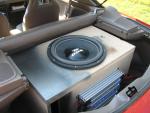
Well since you folks seem to know a thing or 2 I figured I'd come along with my question here too. Here's the details. I've got a pair of Pioneer DVC subs, rated with 4 Ohm per coil. Currently my coils are bridged and my subs are wired parallel, producing a 4 Ohm load. My amp is a Pioneer 1200w mono, with 2+ and 2- terminals (which I believe is for bridging multiple amps/subs) and is 1 Ohm stable.
My problem is that I don't actually WANT to have a 4 Ohm load, because I instantly lose about 35% of my amp's power. What I do want is to wire all my coils in parallel to the amp and produce a 1 Ohm load. While that sounds simple, the issue is that the amp manual says I shouldn't do this. I'm not an expert, but I'm not dumb, but I can't figure out why this is a problem. If the amp is 1 Ohm stable, then it should be fine right? I mean, it's not like the amp can distinguish whether or not the 1 Ohm load it's getting is coming from a single 1 Ohm sub or from a pair of subs wired to produce 1 Ohm...it's all very annoying :S
My problem is that I don't actually WANT to have a 4 Ohm load, because I instantly lose about 35% of my amp's power. What I do want is to wire all my coils in parallel to the amp and produce a 1 Ohm load. While that sounds simple, the issue is that the amp manual says I shouldn't do this. I'm not an expert, but I'm not dumb, but I can't figure out why this is a problem. If the amp is 1 Ohm stable, then it should be fine right? I mean, it's not like the amp can distinguish whether or not the 1 Ohm load it's getting is coming from a single 1 Ohm sub or from a pair of subs wired to produce 1 Ohm...it's all very annoying :S

I dont know the model of your amp, but a lot of monoblocks are wired parallell internally. IE, those two connections are actually only one, so if you are putting 2 ohms into one connection, and 2 ohms into the other connection, the amp is "seeing" 1 ohm.
For example if you left each sub at 4 ohm, connected both, one each to each connection on the amp, then the amp would "see" a final 2 ohm load.
Make sense? Or maybe I didnt understand your question properly.
Possibly your manual is saying do not connect TWO subs at ONE ohm each because then the amp would see a .5 ohm total load and go into protect mode.
John
For example if you left each sub at 4 ohm, connected both, one each to each connection on the amp, then the amp would "see" a final 2 ohm load.
Make sense? Or maybe I didnt understand your question properly.
Possibly your manual is saying do not connect TWO subs at ONE ohm each because then the amp would see a .5 ohm total load and go into protect mode.
John
0 Watt CAFz'r
Joined: Nov 2008
Posts: 27
I maybe didn't explain right, I was tired yesterday, lol. Basically though since it IS in fact 1 Ohm stable, how I produce that 1 Ohm really shouldn't matter as long as I don't go below it, right? But that internal bridge thing, that might actually make sense. I'll test things out later when it's NOT 7:30 in the morning and my neighbors are less likely to call the cops, hah. If I can get 2 Ohm that would be even better than 1, mostly cause I can make the same power with less stress on my amp


0 Watt CAFz'r
Joined: Nov 2008
Posts: 27
Yep, that's pretty much how I had it figured. I guess misunderstandings are bound to happen when you're reading a manual that probably WASN'T in English to begin with, lol. I'll play with it later and get that 1 Ohm, and see what kind of difference it really makes. I'm already intending to make a ported box later, so between those 2 things I should get a considerable difference.

Thread
Thread Starter
Forum
Replies
Last Post
voided
Car Audio Wanted (WTB)
0
May 29, 2007 11:46 PM


